
When you're signing a lease in Quebec, tenant insurance rarely feels urgent. You're focused on the move-in date, the rent, the neighbourhood. Insurance is an afterthought — if you think about it at all.
But the question "do I actually need tenant insurance in Quebec?" is one of the most commonly searched questions by new renters in the province. And the answer is more nuanced than most people expect. This guide gives you the honest breakdown: what the law actually says, what can happen if you go without it, how much it costs, and what to look for in a policy.
What Quebec Law Actually Says
Let's start with the legal reality: tenant insurance is not legally required in Quebec. There is no provincial statute or regulation that mandates every renter carry a policy. So if you were worried about breaking the law by not having it, you're not.
But here's where it gets more complicated.
There is no requirement in the Civil Code for tenant insurance, but a landlord may be allowed to include it as a lease provision. If it's in your lease, it's enforceable just like any other term.
In practice, this means your lease — not the law — is what you need to read carefully. If the contract provides for mandatory tenant's home insurance and you sign, you must provide proof of insurance to the landlord. And if you sign a lease agreeing to carry insurance and then don't get it, there are real consequences. If your lease requires it and you refuse to comply, the landlord may apply to the Tribunal administratif du logement (TAL) to end your lease.
The TAL — the Tribunal administratif du logement — is Quebec's official housing tribunal, created in 1974 and renamed from the Régie du logement in September 2020. It acts as a specialized tribunal to rule on rent increases, lease conditions, noise, heating, repairs, and lease terminations. In other words, if there's a dispute between you and your landlord over tenant insurance, the TAL is the body that resolves it.
So the short version: not legally required, but often contractually required — and practically essential for any renter in Quebec.
Why Your Landlord's Insurance Doesn't Cover You
This is the most dangerous myth in Quebec rental housing. It's commonly misconceived that a landlord's insurance policy already provides the tenant with enough protection. This is not the case — landlord insurance is only there to protect the property owner from financial risk, leaving many gaps in coverage that a tenant would need to purchase themselves.
Here's what your landlord's policy covers: the building structure, shared spaces, and the landlord's own liability. Here's what it does not cover: your laptop, your couch, your clothes, your bicycle, your camera, or any of the belongings you moved into that apartment.
And more critically, it does not cover your legal liability.
If you forget to turn off the tap before going to work and your downstairs neighbour's apartment turns into a swimming pool, you're liable for the damage in their apartment and yours. If a guest comes over for dinner, trips on a rug and hurts themselves, you're liable for their injuries; the insurance will be used to compensate them. If they decide to sue you, your insurance may even cover your legal expenses.
Under the Civil Code of Québec, tenants are responsible for their personal belongings and for any damage they or their guests cause deliberately or through negligence. This isn't a technicality — it's a serious financial exposure. A single water damage incident in a multi-unit building can result in damages worth tens of thousands of dollars. Without tenant insurance, that bill comes to you personally.
What Tenant Insurance Actually Covers
A standard tenant insurance policy in Quebec has three main components:
1. Personal property coverage
This replaces your belongings if they're stolen, destroyed by fire, or damaged by water. Home insurance for apartments provides coverage to replace your property in the event of theft or damage, as well as for relocation costs if your apartment becomes uninhabitable. Think of every item in your apartment — electronics, furniture, clothing, appliances — and ask what it would cost to replace it all at once. For most renters, that number is higher than they expect.
2. Civil liability coverage
This is arguably the most important component. Tenant insurance includes liability insurance, which covers the cost of compensating for bodily injury or property damage unintentionally caused to someone who doesn't live with you. Most policies in Quebec offer $1 million to $2 million in civil liability coverage. Ideally, tenant's home insurance should include tenant's liability coverage of at least $1 or $2 million.
3. Additional living expenses
If your apartment becomes uninhabitable — due to fire, flood, or another insured event — your policy can cover temporary housing, meals, and other costs while repairs are made. This coverage pays for extra living costs if your home becomes uninhabitable.
Some policies also offer optional add-ons: coverage for high-value items like jewellery or professional equipment, identity theft protection, or coverage for a home office. These are worth considering based on your specific situation.
How Much Does Tenant Insurance Cost in Quebec?
This is often the question that surprises renters the most — because the answer is: very little.
According to KBD client data, the average cost of tenant insurance in Quebec is $388 per year in 2026 with a $500 deductible. That breaks down to just $32 per month. Other sources put the figure slightly higher: in 2025, the average rate for tenant insurance in Quebec is about $36 per month. Some providers offer entry-level policies starting even lower — with policies starting at $12 a month, tenant insurance in Quebec is cheaper and more affordable than most renters realize.
To put that in perspective: for the cost of one or two coffees per week, you get protection for all your belongings and up to $2 million in civil liability coverage.
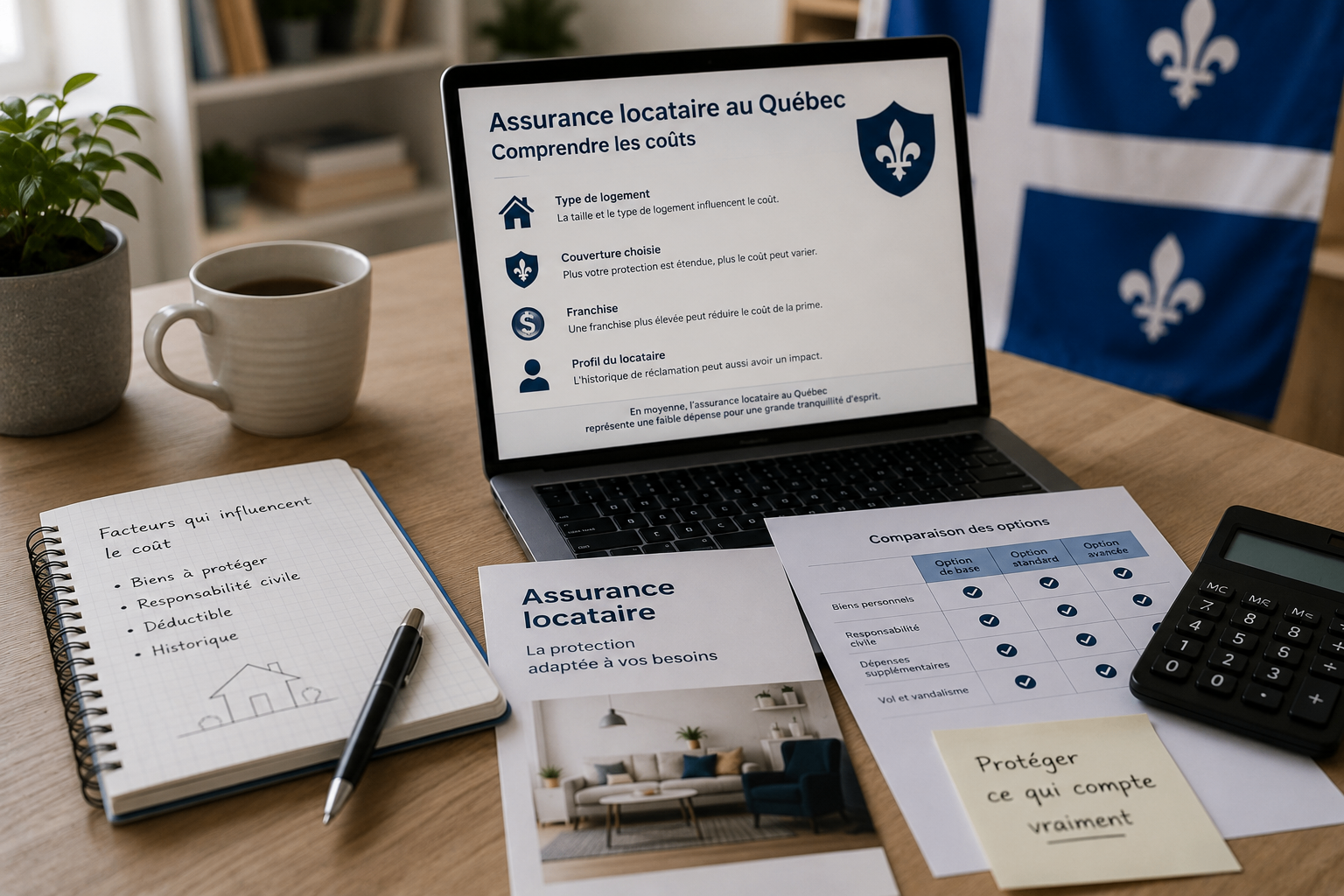
The factors that affect your specific premium include:
- The value of your belongings. The more you're insuring, the higher the premium.
- Your location. Urban areas generally have higher premiums due to increased risks of theft and vandalism.
- Your building type. Tenants in fire-resistant buildings pay less on contents insurance because the risk of fire is lower.
- Your deductible. A higher deductible means a lower monthly premium.
- Whether you bundle. Combining tenant insurance with car insurance through the same provider often unlocks significant discounts.
How to Choose the Right Policy
Not all tenant insurance policies are the same. Here's what to look for:
Check the coverage type: replacement cost vs. actual cash value. Replacement cost coverage pays to replace your item with a new equivalent. Actual cash value pays the depreciated value — meaning your five-year-old laptop might only get you a fraction of what it costs to replace it. Replacement cost coverage is worth the slightly higher premium.
Verify the liability limit. A $1 million civil liability limit is the standard minimum. If you frequently host guests or have young children, consider $2 million.
Read the exclusions carefully. Most standard policies don't cover flooding from external water sources (like a river overflowing) unless you add specific coverage. If you live in a basement apartment or a flood-prone area, ask specifically about this.
Get proof of insurance in writing. Your landlord may ask for a certificate of insurance — an official document from your insurer confirming your active policy — before or when you move in. This is an official document from your insurer confirming your active policy, often needed for your landlord.
Shop around annually. Don't auto-renew without comparing. Premiums change, and so does your situation. Shopping your policy each year at renewal can meaningfully reduce what you pay.
A Note for Students
If you're a student moving into your first apartment in Montreal, Quebec City, or Gatineau, you may already be partially covered — but likely not completely. If you are a student under the age of 25 coming to live in a residence, you could be covered by your parents' homeowner's insurance, which covers liability and property. However, you may need tenant insurance in your name if you are permanently away from your parents' home. Contact your parents' insurer to verify the scope of coverage before assuming you're protected.
The Bottom Line
Tenant insurance is not legally required in Quebec. But saying you "don't need it" because it's not the law is like saying you don't need a seatbelt because you're only driving around the block.
Without tenant insurance, you risk financial loss and legal liability if something goes wrong. A single incident — a kitchen fire, a burst pipe, a guest injury — can generate tens of thousands of dollars in damages. Your landlord's insurance won't cover you. Your building's insurance won't cover you. Only your own policy will.
For most Quebec renters, tenant insurance costs between $15 and $40 per month. That's real protection for a cost most people won't notice in their monthly budget.
Check your lease. If tenant insurance is required, get it before you move in. If it isn't required, get it anyway — and have the peace of mind that comes with knowing you're covered.
Looking for an apartment in Quebec? Browse verified listings across Montreal, Laval, Longueuil, Gatineau, Trois-Rivières, and more at Rentack.com. No fees, no middlemen — direct contact with landlords.
Sources: Civil Code of Québec (Book Five – Leases of Dwellings); Tribunal administratif du logement (tal.gouv.qc.ca); KBD Insurance (2026 Quebec tenant insurance data); Sonnet Insurance (2025 Quebec premium data); Ratehub.ca; Éducaloi.