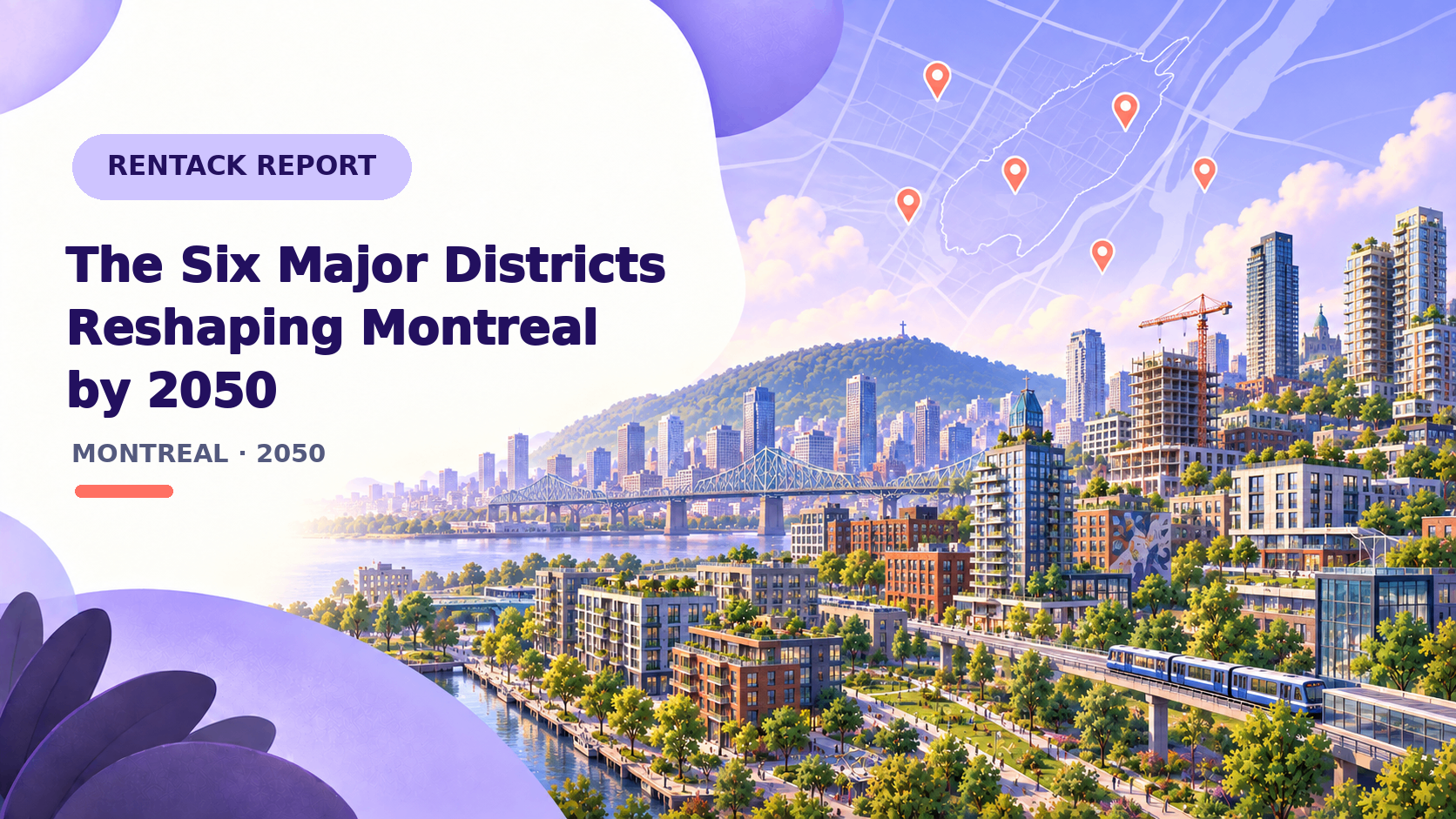
Not many people know this, but the City of Montreal has spent years planning six entirely new neighbourhoods on underused, industrial, or municipally-owned land. Taken together, these six districts — Bridge-Bonaventure, Namur-Hippodrome, Lachine-Est, Louvain-Est, Les Faubourgs, and the corridor around the Blue Line metro extension — could eventually house more than 130,000 new housing units. Here's a detailed look at each one, including the most recent developments.
Namur-Hippodrome: the most ambitious, and the slowest to get moving
Located on the site of the former Blue Bonnets racetrack, straddling the Côte-des-Neiges–Notre-Dame-de-Grâce and Saint-Laurent boroughs, this is by far the largest of the six: between 18,500 and 20,000 housing units are planned in total, more than half of them shielded from speculation. The master development plan (PDAD) was adopted in December 2024, after years of discussion.
The project is coordinated by GALOPH (Groupe d'accélération du logement de l'ancien hippodrome), an organization bringing together the city, provincial and federal governments, and community groups. The first phase, set to start in spring 2027 in the section closest to Décarie Expressway, will include roughly 2,400 to 2,500 below-market units, with the first move-ins expected in 2029. Investment for this first phase alone reaches $320 million, of which $192.5 million comes from the city.
The file has seen several concrete developments recently:
- July 2026: the borough launched the authorization process for a private project of 1,225 rental units across four towers of 20 to 30 storeys, at the corner of Décarie Boulevard and Namur Street — the first private project in the sector, including a 4,500 m² municipal sports centre.
- September 4, 2026 (less than three weeks ago): the city announced a project led by the non-profit Communia for at least 225 units aimed at seniors and low-income households, a sign of renewed momentum after a partner withdrew from the original plan.
The sector will also include schools, neighbourhood retail, and health services, with a transit network that could include a tramway line.
Bridge-Bonaventure: the newest, and the greenest
Unveiled in March 2025, the master development plan (PDMV) for the Bridge-Bonaventure sector — wedged between Old Montreal, Griffintown, and Pointe-Saint-Charles — calls for up to 13,500 housing units across 2.3 km², 6,000 more than what was originally presented. About half of the units in the Wellington Basin and Pointe-Saint-Charles triangle sectors will be protected from speculation, thanks to an agreement with the federal government and the Canada Lands Company.
The plan includes 43 hectares of green public space, including a riverside promenade, a swimming area at the Wellington Basin, and expanded access to the St. Lawrence River and the Lachine Canal. On the economic side, 600,000 m² will be reserved for economic and institutional activity, including the creation of a "Quartier des artisans" blending economy and heritage. The sector will also benefit from 12 km of new bike lanes and a REM station.
Construction can begin as early as 2026 on land already served by existing infrastructure.
Les Faubourgs: two major projects in one
The Faubourgs sector, east of downtown along the river, covers 53 hectares and calls for 7,500 housing units, nearly half of them social or affordable. The Faubourgs PPU, adopted in 2021, plays out concretely through two distinct major projects:
Quartier Molson, on the site of the former Molson Coors brewery, is led by Groupe Montoni. Sohmer Park will serve as its green anchor, and the developer says it wants to preserve the site's industrial soul while creating a genuine mixed-use neighbourhood. The project requires extending several existing streets — Viger Avenue, de la Visitation Street, and Atateken Street — to reconnect the sector with the rest of the Faubourgs' street grid. Expected timeline: roughly ten years.
Quartier des Lumières, developed by Groupe Mach and Devimco on the former Radio-Canada tower site, will bring more than 2,500 new residential units, nearly 550 of them social housing.
The PPU also calls for expanded pedestrianization of Sainte-Catherine Street and better traffic control on Ontario Street, aimed at revitalizing the Village.
Lachine-Est: the former City of Iron and Steel
This vast 70-hectare territory, bounded by the Lachine Canal, Victoria Street, 6th Avenue, and the CP rail lines, long carried the nickname "City of Iron and Steel" because of its industrial past (Dominion Bridge, Stelfil, Allis-Chalmers). The PPU, adopted in June 2023 after a consultation process that began in 2019, calls for a potential 7,800 housing units, with a full conversion expected to unfold over at least twenty years.
The project leans on showcasing the site's industrial heritage — historic buildings, overhead cranes, rail lines — rather than erasing its past entirely. The sector could eventually be served by the western branch of the future Pink Line, currently under study by the ARTM. The commercial revitalization of Notre-Dame Street, already well underway, is also expected to benefit from the project.
Louvain-Est: the most citizen-driven of the six
The Louvain eco-district, in Ahuntsic-Cartierville, stands out for how it came to be: citizens mobilized since 2007 pushed the project forward, on a former municipal pound site covering 7.7 hectares. The site calls for roughly 1,000 permanently affordable housing units, at least 50% of them social and community housing, plus an elementary school, a daycare (CPE), a community centre, a social economy incubator, and nearly 15,000 m² of public space — a public square, a landscaped pedestrian walkway, a protected wooded area.
After many delays, construction has finally begun on a first 323-unit affordable complex targeting LEED certification, named Terra Nostra and owned by a non-profit organization. Financing for this first building reaches roughly $140 million, from the federal and provincial governments and the city.
The Blue Line corridor: densification through transit
Less often presented as a "district" in its own right, the corridor around the five future stations of the Blue Line metro extension (Pie-IX, Viau, Lacordaire, Langelier, and Anjou) nonetheless represents one of the island's largest densification opportunities: up to 25,000 new housing units, an upward revision from the original 18,500 estimate.
Around Langelier station alone, the Langelier master plan calls for 6,000 to 8,000 housing units, developed in part by Groupe MACH in partnership with Transgesco, the STM's real estate subsidiary. The sector will include public squares, bike lanes, and a link to Boisé-Jean-Milot park. In southern Saint-Léonard, the population could nearly double by 2050, from roughly 30,000 to close to 59,000 residents.
The sector is already drawing private interest: in Anjou and Saint-Léonard, at least seven real estate projects totalling more than 1,000 units are underway or under study, including towers of 11 and 20 storeys on Louis-H.-La Fontaine Boulevard. To finance infrastructure, the ARTM now charges developers a levy of $132 per square metre on projects within a one-kilometre radius of the future stations — the same rate applied to the REM.
Summary table
Namur-Hippodrome — CDN–NDG / Saint-Laurent Planned units: 18,500 to 20,000 Status (September 2026): first phase (2,400-2,500 units) starts spring 2027; private 1,225-unit project in authorization
Bridge-Bonaventure — Ville-Marie / Sud-Ouest Planned units: up to 13,500 Status (September 2026): construction possible as early as 2026 on already-serviced land
Les Faubourgs (Molson + Lumières) — Ville-Marie Planned units: 7,500 Status (September 2026): Quartier des Lumières underway; Quartier Molson on a ~10-year horizon
Lachine-Est — Lachine Planned units: 7,800 Status (September 2026): PPU adopted (2023); conversion over ~20 years
Louvain-Est — Ahuntsic-Cartierville Planned units: ~1,000 Status (September 2026): first building (Terra Nostra, 323 units) under construction
Blue Line corridor — Saint-Léonard / Anjou Planned units: up to 25,000 Status (September 2026): 5 stations under construction; several private projects already launched
What this means for future renters
These six districts represent, in total, a potential of more than 130,000 housing units — a scale that dwarfs the individual projects covered in our other articles, like our overview of Montreal's major rental projects or our deep-dive on Griffintown and downtown. Most of these districts won't deliver their first units for several more years, but understanding these plans makes it possible to anticipate where rental supply will actually grow across the island over the next decade — well beyond the projects already under construction today.
Where to find official maps and renderings
- Namur-Hippodrome — official page with maps and planning vision: montreal.ca
- Bridge-Bonaventure — press release with master plan visuals: Portail Constructo
- Les Faubourgs — official PPU page: montreal.ca — and consultation documents with plans: OCPM
- Lachine-Est — official page with PPU documents: montreal.ca
- Louvain-Est (Écoquartier Louvain) — official page with planning vision: montreal.ca
- Blue Line extension — official project page with station maps: ARTM
Bottom line
Over a generation, these six projects could reshape Montreal's landscape more than any single initiative since the metro was built in the 1960s. Namur-Hippodrome and Bridge-Bonaventure are the two files worth watching most closely in the coming months, with concrete developments clearly accelerating since spring 2026.