Montreal vs Quebec Regional Cities: Where Should You Rent in 2026?
Montreal gets the headlines. The 11.9% rent increase on the island in 2025. The $1,346 average for a two-bedroom. The vanishing supply of units under $1,300 a month. But Quebec is a large province, and some of the most significant rental stories in 2025 happened in cities 90 minutes from Montreal where rents are dramatically lower — and in some cases, falling even further behind the island. Here is a data-driven comparison of what it actually costs to rent across Quebec's major cities, and what you get for the difference.
The Baseline: What Renting in Montreal Costs in 2026
CMHC data for Montreal Island, 2025:
2025 — Avg. rent (all sizes): $1,283/month | Avg. rent (2-bedroom): $1,346/month | Rent change: +11.9% | Vacancy: 3.1%
Vacant units — those actually available to new renters — averaged $1,573/month versus $1,275 for occupied units. The 23% premium paid by new renters versus existing tenants is one of the key drivers of housing stress: tenants who can afford to stay, stay, which further restricts supply.
Within the island, the variance is enormous. A 3½ in Hochelaga-Maisonneuve (HOMA) averages $1,368/month; in the Plateau-Mont-Royal, closer to $1,817/month. NDG runs around $1,688/month per Narcity data. Rosemont is an outlier — rents stayed flat at $1,237/month in 2025, an anomaly explained by unusually low tenant turnover.
The Comparison: 9 Cities, Real Numbers
Gatineau — Highest Average Rent in Quebec
2025 — Avg. rent: $1,420/month | Rent change: +6.8% | Vacancy: 3.8%
Gatineau is actually more expensive than Montreal island for average rents — the only Quebec city that can make that claim. The explanation is the federal public service: tens of thousands of civil servants calibrated to federal salary scales live here, pulling rents toward Ottawa levels. The 3.8% vacancy rate (Quebec's highest among major cities) is driven by new construction concentrated in expensive segments — vacant new units hit 10% vacancy while affordable units barely exist. To rent in Gatineau without spending more than 30% of income, FRAPRU calculates you need at least $56,800/year.
Vs Montreal: Gatineau is more expensive on average, but offers more vacancy in the market segment. Ottawa proximity is either an advantage or irrelevant depending on where you work.
Quebec City — Fifth Most Expensive, Fastest-Growing Data
2025 — Avg. rent: $1,232/month | Rent change: +6.7% (record high) | Vacancy: 2.4%
Quebec City is the province's capital, home to Université Laval (45,000+ students) and a major civil service employment base. The Ville de Québec itself called the 6.7% increase a "record level." Occupied units average $1,220/month; vacant units asking $1,488/month — a 22% gap. The neighbourhood spread is significant: Limoilou offers better value than Saint-Jean-Baptiste or Montcalm.
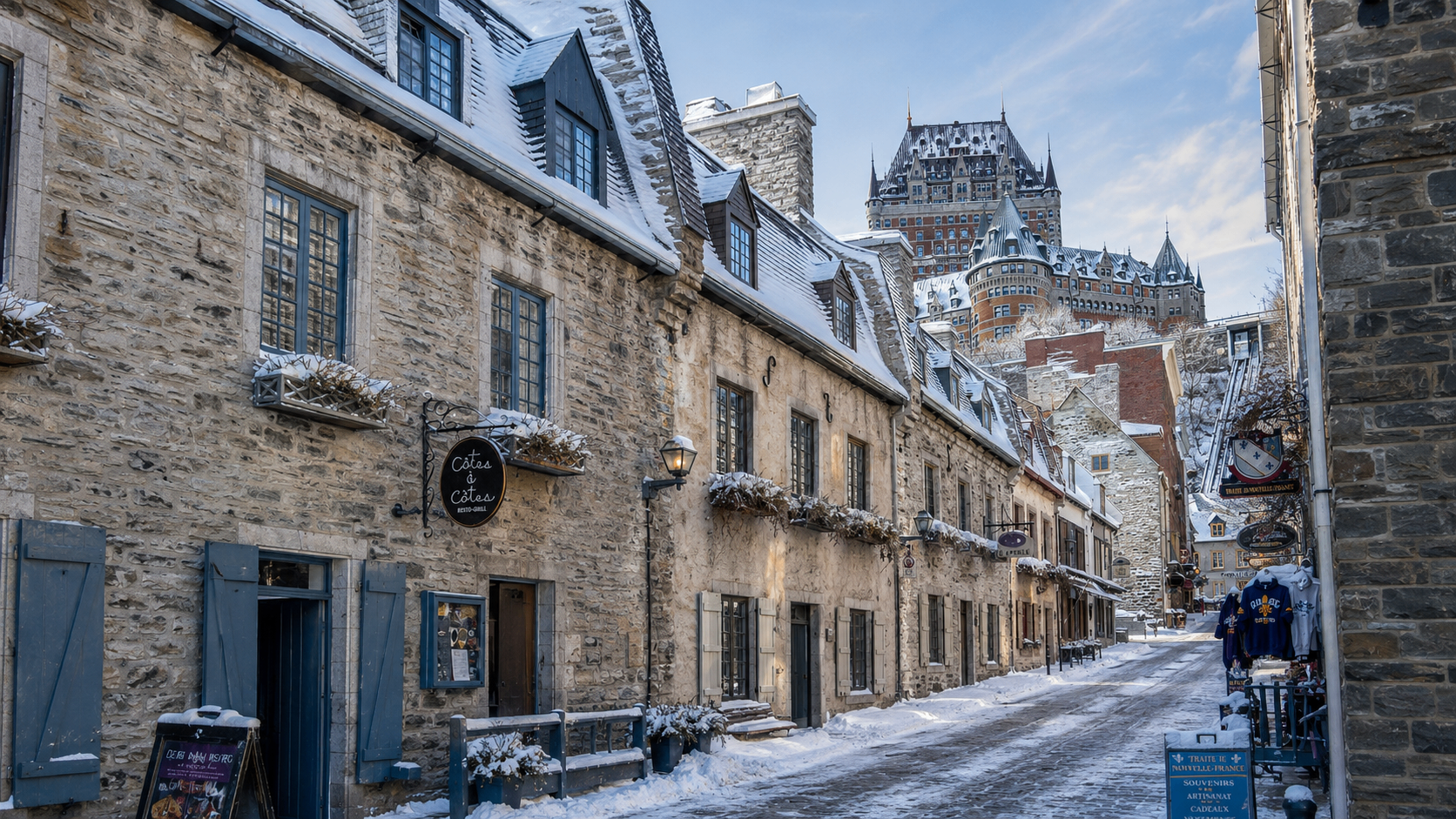
Vs Montreal: About 10% cheaper on average, with a similarly tight supply of affordable units. Strong quality of life, walkable Old City, no equivalent to Montreal's cultural diversity.
Sherbrooke — Best Mid-Size University City Value
2025 — Avg. rent: $1,432/month | Rent change: +9.3% | Vacancy: 2.7%
Wait — Sherbrooke more expensive than Quebec City? The CMHC average for Sherbrooke in 2025 reflects strong demand from UdeS (31,000+ students) and Bishop's University, combined with a smaller overall rental stock. Despite the higher average, Sherbrooke's quality of life per dollar is strong. Six distinct boroughs give renters real choices: Mont-Bellevue for student life, Jacques-Cartier for downtown access, Fleurimont near the CHUS hospital, and quieter Brompton and Rock Forest for families.
Vs Montreal: Roughly equivalent in average rent, but dramatically lower cost of living overall (food, transportation, entertainment). Sherbrooke doesn't make sense purely on rent savings over Montreal — it makes sense if you're working or studying there.
Trois-Rivières — Fastest Rent Growth in Quebec
2025 — Avg. rent: est. $1,100–$1,200/month | Rent change: +15.2% (highest of any Quebec CMA) | Vacancy: 2.7%
Trois-Rivières recorded the highest single-year rent increase of any metropolitan area in Quebec in 2025 — +15.2%, per CMHC data compiled by FRAPRU. Despite this surge, rents remain well below Montreal, Quebec City, or Sherbrooke in absolute terms. The city at the midpoint of the province (1h30 to Montreal, 1h15 to Quebec City on the A-40) is one of the few places in Quebec where a renter can genuinely save $400–$600/month versus Montreal while staying connected to both metros.
Vs Montreal: Rents 30–40% lower in absolute terms even after the 15.2% jump. Via Rail connections to both Montreal and Quebec City. The mid-province positioning is genuinely useful for certain employment profiles.
Drummondville — The Montreal Alternative With a Train
2025 — Avg. rent: est. $1,000–$1,150/month | Rent change: +13.6% | Vacancy: 1.8%
Drummondville recorded the second-steepest rent increase among Quebec RMAs in 2025 (+13.6%), driven heavily by Montreal emigration. Even so, rents here are typically $400–$600/month less than Montreal equivalents. Via Rail connects Drummondville to Montreal in about 1h15. Highway 20 gives a 1h45 drive to Montreal, 1h15 to Quebec City. For a hybrid worker who needs to be in Montreal two or three days a week, Drummondville makes compelling financial sense.
Vs Montreal: Save $4,800–$7,200/year on rent. Trade: daily commute becomes a genuine cost in time and transportation. Best suited for hybrid workers or families where one partner works locally.
Saguenay — The Only Metro Where Vacancy Got Tighter
2025 — Avg. rent: $941/month | Rent change: +11% | Vacancy: 1.3% (down from 1.6%)
Saguenay is the single Quebec CMA where the vacancy rate actually fell in 2025 — the opposite of the provincial trend. The 1-bedroom (3½) average of $762/month saw a 15% jump, yet remains dramatically cheaper than Montreal equivalents at $1,368/month (HOMA) to $1,817/month (Plateau). Chicoutimi-Nord hit 0% vacancy; Jonquière went from 2.5% to 1.6%; La Baie held at 0.7%.
Vs Montreal: Rents roughly 30–35% below Montreal for comparable units. Major employer: Rio Tinto Alcan, UQAC, Cégep de Jonquière. Quality of life anchors: the Saguenay fjord, outdoor access, genuine neighbourhood character. The trade-off is the 2h30–3h drive from Montreal (no fast rail link).
Granby — 37% Jump in 3 Years, Still Affordable
2025 — Avg. rent: $1,103/month | Rent vs 2022: +37% in 3 years | Vacancy: est. <1%
Granby's 37% cumulative rent increase between 2022 and 2025 — from $805 to $1,103/month — is one of the fastest documented for any Quebec city over this period. Yet even at $1,103, Granby remains cheaper than Montreal, and vastly cheaper than neighbouring Bromont ($1,661/month in 2025). For renters priced out of the Eastern Townships resort towns, Granby is the natural fallback — and 80km from Montreal via the A-10.
Vs Montreal: About 20% less than Montreal average, 35% less than most Plateau or NDG equivalents. Eastern Townships access without resort-town pricing.
Rouyn-Noranda — One of the Rare Rent Decreases
2025 — Avg. rent: $871/month | Rent change: -4.2% | Vacancy: 1.0%
Rouyn-Noranda is an anomaly worth noting: one of the only Quebec cities where rents actually decreased in 2025. That -4.2% drop reflects softening mining sector activity and modest population shifts. At $871/month average, it's among the most affordable cities in the province with full urban services.
Vs Montreal: About 32% below Montreal average rent. Significant lifestyle trade-off: 8-hour drive from Montreal, 7 from Quebec City. Makes sense for workers in the Abitibi mining economy, not for Montreal-area commuters.
The Real Comparison: A 10-Year Savings Calculator
If a Montreal renter paying $1,650/month for a 2-bedroom moved to Trois-Rivières and paid $1,050/month for an equivalent (after the 15.2% increase), the monthly saving is $600. Over 10 years, that is $72,000 in cumulative rent savings — not accounting for rent increases in either city, transportation costs, or any other variable.
At Drummondville ($1,050/month), the same calculation yields $600/month or $72,000 over 10 years. Add $300–$400/month in transportation costs for a Via Rail commuter to Montreal 3 days/week, and the net saving drops to $200–$300/month — still meaningful, but the decision becomes more nuanced.
The calculation that works most clearly: families where both partners work remotely or in the regional city, who save $600+ per month with no transportation offset.
What You Lose and What You Gain
What you lose leaving Montreal: Cultural density (museums, live music, restaurant variety, festivals, professional sports), career network proximity, diversity of employer options, non-car transit options, proximity to major airports.
What you gain in regional cities: Significantly more space for the same or lower rent, faster commutes within the city, outdoor access (the fjord in Saguenay, the Eastern Townships in Granby, the St. Lawrence in Trois-Rivières), lower overall cost of living, and in most cases, a slower pace of daily life that many renters actively prefer.
The hybrid work wildcard. The expansion of remote work since 2020 fundamentally changed this calculation. A software developer who earns a Montreal salary but works remotely 4 days a week can live in Drummondville, pay $600/month less in rent, and go into the office one day a week. For this profile, regional cities offer the income of a large market with the cost structure of a smaller one.
Where to Find Rentals Across Quebec
Rentack lists apartments for rent across the entire province — from Montreal neighbourhoods to Saguenay, Trois-Rivières, Sherbrooke, and the Gaspésie. All listings are long-term rentals, not tourist accommodation. Browse apartments across Quebec at rentack.com.
Sources: CMHC Rental Market Report 2025; FRAPRU compilation December 2025; Le Réveil Saguenay December 2025; Radio-Canada BSL December 2025; Narcity Quebec 2025; Courrier du Sud January 2026; Granby Express February 2026; Est Média Montréal December 2025. Compiled by Rentack, July 2026.